[vc_row][vc_column][vc_column_text]Karlheinz Stockhausen (1928–2007) Michaels Reise um die Erde (1978)
Act 2 of Donnerstag aus Licht
Opera in three acts, a greeting and a farewell
Concert performance
Karlheinz Stockhausen is considered as the inventor of pointillist music and moment form. The major representative of serialism was a pioneer of aleatoric and electronic music and also of abstract spatial composition. He acted as an unparalleled primary influence within the sphere of European post-war modernism, viewing the “zero hour” after the destruction during World War II as a historic opportunity for a radical new beginning. In his opera cycle Licht (Light), composed between 1977 and 2003 with the seven segments corresponding to the seven days of the week, he created a syncretic world theatre of creation with a total duration of around 29 hours, revolving around the archangel Michael, his adversary Lucifer and the ‘maid of the stars’ Eva in a monumental Gesamtkunstwerk of superlatives. The solo trumpet in Michaels Reise um die Erde represents the protagonist during a symbolic excursion into his own ego in which the music is a stylistic recreation of its individual stages (including Japan, Bali, India and central Africa). In Jerusalem, Michael finally encounters Eva with whom he becomes musically amalgamated in a “dense trill” (Stockhausen) in Himmelfahrt.[/vc_column_text][/vc_column][/vc_row][vc_row][vc_column][vc_single_image image=”2022″][/vc_column][/vc_row]
Ernstalbrecht Stiebler, from the mid-1960s onward, reduced a few sounds to even fewer, composing his music for a small circle of musicians with whom he maintained an active exchange. In doing so, he distilled what was essential to his work: invitations to listen, ever-new formulations of the idea of an inner auditory space that he invites the listener to enter. With a calm intensity, Stiebler’s music turns toward the single tone, fluctuation, and interval, giving rise to a music that may seem foreign while making an unfamiliar space perceptible. His music does not lend itself to emotional projection. In a conversation, he stated:
“Music is too important to be burdened with emotions.”
Thus, his pieces are usually sequences of quiet steps into the open—highly precise despite their freedom. Through the means of repetition, they become continuous acts of bringing the here and now into presence. Stiebler pursued a path that is nearly singular within Western contemporary music since the mid-20th century, related to John Cage, Morton Feldman, and Giacinto Scelsi, as well as to composers of his generation such as Christian Wolff, James Tenney, and La Monte Young. With persistence and depth, he followed an artistic path that a younger generation of musicians, composers, and listeners is now approaching.
In 2024, we (Biliana, Hauke and I) organized the EA:90 festival to mark Ernstalbrecht Stiebler’s 90th birthday. The festival was largely shaped by musicians who were very close to Stiebler and who had worked on his music with him over many years, in some cases since the 1990s. Unfortunately, Ernstalbrecht Stiebler was unable to attend the festival and passed away a few weeks later. Among his estate are works that have not yet been performed, which Stiebler dedicated to musicians from the festival circle and on which he had already worked with them; these form a central component of The Long Night for EA.
The concert combines music and film. It includes the aforementioned premieres, two important works from the 1980s, as well as an extended piece for cello and delay.[/vc_column_text][/vc_column][/vc_row][vc_row][vc_column][vc_single_image image=”2022″][/vc_column][/vc_row]
[vc_row][vc_column][vc_column_text]“When music gives us space, gives us time, we notice how our perception changes the music. Thus, music becomes sensitized through differentiated, repeated structures that do not force the listener to merely follow what the composer has pre-conceived, but instead allow for participation—creating resonance in the broadest sense.”
–Ernstalbrecht Stiebler
Since the 1960s, Ernstalbrecht Stiebler has been reducing a few sounds to even fewer, distilling what is essential in his work: an invitation to listen, to continuously reimagine an inner space of hearing that he invites us to enter. With calm intensity, Stiebler turns his attention to a single tone, a fluctuation, an interval—allowing a sound space to emerge that feels unfamiliar. Through repetition, his music becomes a continuous manifestation of the here and now. His music resists emotional projection. As he once stated in an interview:
“I think music is too precious to be consumed merely for fleeting emotions.” – Ea. S.
As an outsider, he has persistently and rigorously pursued an artistic path—one that is now being met by younger generations. EA:90 is curated by three artists who have worked closely with Ernstalbrecht Stiebler for many years: Hauke Harder, Biliana Voutchkova, and Tilman Kanitz.
The concert Monochromy focuses on Stiebler’s compositions from the 1990s and his piano works. The concert Extension features Stiebler’s 1963 string trio Extension III, alongside recent works and music by female composers influenced by his approach. In the staged concert Sensitivity, ensemble and vocal works will be premiered.
In recent years, Ernstalbrecht Stiebler has spoken about his music in terms of freedom and sensitivity—a new sensitivity. Based on this idea, EA:90 is a celebration of listening together.
An Installative Concert by Tilman Kanitz and Sebastian Blasius
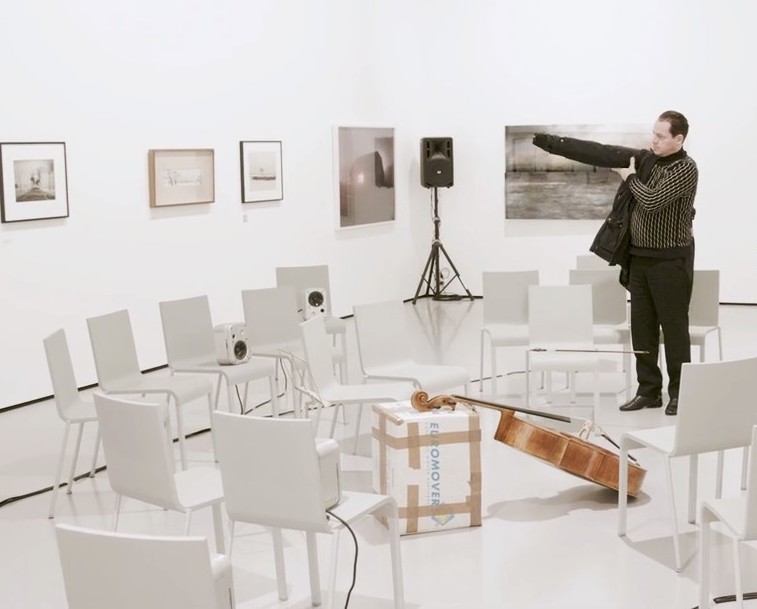
Concentric circles of chairs, a cellist, voices and cryptic sounds from loudspeakers evoking at times dissonant, absurd, and enigmatic images. In recent years, we have increasingly been shaped by the experience of how our Western self-understanding is crumbling—many had not anticipated the scale of the pandemic or the war in Ukraine. Perhaps we must learn a new form of perception in order to anticipate the unknown?
The installative concert under the ice, created by the artist and curator Tilman Kanitz and the director Sebastian Blasius, explores the relationship between what exists and its erosion. The foundation of the work includes an electronically slowed-down Sarabande for solo cello by Johann Sebastian Bach, as well as poetry by early Expressionist Georg Heym. The piece invites the audience to reflect on our present—and beyond—through processes of imagination and association.
Press quote by Rheinische Post: “These are confusing, icily cold, and often painful worlds of imagery that Blasius and Kanitz pick up on and literally bring to sound, (…) until only a single word remains—until even that word loses its meaning through constant repetition and dissolves into pure sound. In this way, the audience becomes witness to erosion; they experience disintegration, decay, and loss in their own listening experience. (…) Toward the end, as the words forget and skin have taken root, (…) cello sounds overpower the noise from the speakers, (…) bringing everything heard and experienced together into a fascinating whole.”
Text about Stiebler’s and Kanitz’ collaboration by Matthias R. Entreß:
Improvisation is not a common practice in New Music, where compositions, down to the last detail, are set out in writing and are entrusted to highly virtuoso and best-rehearsed instrumentalists for their performance. Indeed, it is even rare for the composer and player to be the same person. So it was all the more surprising when in 2019 Ernstalbrecht Stiebler, composer of music categorized as reductionism, began to meet with cellist and composer Tilman Kanitz in the latter’s studio for improvisations, eventually recording them for this disc.
In this encounter, different experiences meet like magnetic poles. Tilman Kanitz, formerly artistic director of Solistenensemble Kaleidoskop, has gathered musical experiences from across the world, particularly in India, which benefited his sensibility for complex sounds and for the liveliness of calm, while Stiebler was among the first in Germany and Europe who in the 1960s broke away from the expressionist avantgarde to shape a new kind of listening, a more quiet and concentrated one.
The respective roles seem obvious: the cello will create a basis with sustained sounds for the piano’s sweeping movements on top. But it isn’t quite so simple, as Kanitz, long trained in microtonality and Just Intonation, directs the sound of the cello into a sphere inaccessible to the piano and its fixed pitches, keeps altering the sound, and the way the two instrumental languages or even worlds engage in a cautious interaction results in a mutual exploration of a temporal topography.
Tilman Kanitz explains: “For me, making music is a meditative research process. Playing with Ernstalbrecht Stiebler, I feel that I’m moving in spaces inbetween, that the tonal space that I contribute comes in contact with the tonal space played by the pianist. They intersect and overlap, move apart, for me this is a deeply spatial experience . . .”
And Ernstalbrecht Stiebler adds: “Music has a much more farreaching impact, it is the medium by which we experience space, feel it in fact, also within ourselves, subconsciously, or we hear how the cello moves across a variety of interconnected spaces. Here and now: this immediacy is the chance and the quality of improvisation. Find the courage to hear the depth and the stillness, the power of space, and to realize it.”
What distinguishes improvisation from composition for those who listen, for the audience, is their completely different activation of listening behaviour. Improvisation is not predetermined, and as this music is created newly in every moment, it subliminally signals its being at peril. Because of this, the listeners become participants in a social situation. The Max Planck Institute for Human Cognitive and Brain Sciences in Leipzig already verified in 2010 by experiments that when people listen to an improvisation, even if they cannot distinguish it from a composition, their amygdala, the centre for compassion in the brain, is surprisingly stimulated much more strongly than during a prepared performance (A. Engel, P. E. Keller: The perception of musical spontaneity in improvised and imitated jazz performances. Frontiers in Psychology 2:83.). Improvisation, then, inevitably causes you to be more mentally alert, more ready to run to help, as it were.
Stiebler’s works since the 1960s have been documents of a progressive condensation of sounds and structures – so the current new freedom is at least unexpected: “I do perceive it as a natural continuation. There have always been possibilities to evolve, within the sounds, and I’ve found that out only now, through the collaboration with Tilman. So many pieces are written out so rigorously and there’s no way to break out, which is really a pity, but with a certain openness for what comes out of your fingers spontaneously, it’s sometimes much better than having intended it.”
The playing styles of the two musicians in the recordings of this LP are certainly dissimilar, Kanitz and his sustained sounds creating a different sense of duration than Stiebler as he meanders in this sonic spacetime continuum, but the subtle transformations in his play keep putting the pianist in new situations – and vice versa.
This freedom of movement among the intuitively created sounds doesn’t run counter to the two musicians’ common pursuit of reduction, as they both remain listeners. Each sound here is created with respect for silence.
For all the caution in their exploration of their music together, the compositional experience of either musician is not rendered obsolete. Kanitz: “I would even explicitly call it artistic creation. Then again Instant Composing would fit as a term here, it is indeed artistic creation in the moment, with the aspiration of putting it down” – namely in the form of these recordings, documents of both a most refined aesthetic interaction as well as a musical narrative in its own right.
Text: Matthias R. Entreß
Recorded and mixed 2020–2022 at Studio Tilman Kanitz
The cover art shows many streams entering a lake, and rising to mist in the warmth of the setting sun. Improvisation is like the water, transmutable, reflective. It carries in it, what it has touched, what it has lived. When we think of improvisation, we might also think of Jazz, and patterns of city life, a specific kind of human togetherness, that it spoke throughout the 20th century. If the improvisations of Tilman Kanitz and Ernstalbrecht Stiebler are of that lineage, you could say, that their Jazz, their improvisation, takes place in the undoing of those patterns. Their improvisation is reflective of an evolution in human togetherness, one which integrates vastness, emptiness, darkness, radiance, like the language of landscapes, rain, sunlight, cosmos, consciousness. It is the water which has touched aloneness and uncertainty, yet is fluid, curious, playful, even blissful. It is the water which does not name, does not judge, but flows, sparkles, dances.
Interview of the label manager Simon Reynell with Tilman Kanitz:
Simon Reynell: Could you tell us how and when your duo with Ernstalbrecht came about?
Tilman Kanitz: At a festival for North Indian Classical music in Calcutta I was impressed by the extensive “tuning up” process of the musicians. I thought of Ernstalbrecht and wrote to him, suggesting that he should write a cello piece for me. A couple of months later, at the concert in Berlin where I premiered this solo, he asked me if I would like to improvise with him. That was in early 2019. Since then we have been meeting, almost weekly, to improvise and record ourselves in my studio in Berlin Pankow.
How long has each of you been playing improvised music?
Ernstalbrecht says he started improvising music with me, shortly before his 85th birthday. I started improvising when I was 5 years old, together with my sister. And since then, improvising music on the cello, the piano, and other instruments has played an important role in my life. But it’s only with Ernstalbrecht that it has become a regular practice, and this is the first release of our improvised music for both of us.
I find it incredibly impressive that anyone can start improvising at the age of 85, and immediately do it so well. But are you improvising completely freely? To my (unmusical) ears, there seems to be some kind of modal system underlying the music. How much discussion, planning and preparation do you have before each session?
When we started improvising together it was a musical dialogue right away, with no discussion, planning and preparation. The only remark I remember is that at one point I made a request to play less notes. And on another occasion Ernstalbrecht asked me to play longer notes. These were the only two moments in our work when it seemed necessary to formulate one’s wish to the other. Despite that, each improvisation is simply accepted by us, and starts without any previous arrangement of any kind. The only intention is to meet at a certain time, and play, alternating who begins. We develop the pieces in real time with no revisions, trusting in the full breath. The music is predetermined by what we did before, trusting in the now, the expansion in the now, the play in the now. We listen to the recording two or three times, then play again. When we write to each other, we comment only on positive things, never mentioning what doesn’t or didn’t work, but communicating and building only on what did.
I think of Ernstalbrecht’s composed music as being wonderful, but quite austere. Yet the music you improvise together seems quite different – much more emotionally-driven, almost romantic….?
Ernstalbrecht’s composed music is meant to be played in public. The idea is to unburden music from emotions, and to enable the listener to create inner spaces, in order to encounter oneself. It is a highly individualized musical experience, unique for each listener. Our common music, on the other hand, is not meant to be played in public initially. It is our private dialogue about each of our musical histories. Ernstalbrecht says that, for him, our improvisations are a way of making it possible to deal with music history. Maybe improvising is for both of us simply the echo, the memory of a Mozart Sonata, or Liszt’s Petrarca Sonnet 104, or classical Persian music we listened to.
Yes, Ernstalbrecht described your music as “a new freedom to handle tradition” and says he is primarily using fifths and octaves. Your duo does seem to engage with melody more than other improvisations I listen to. Were you surprised that the music took that particular direction?
To be honest, I am surprised each time I listen to our music. I am surprised by these hints of melodic fragments, woven into the progressions. Sometimes they sound like extremely stretched particles of musical sediments, the remnants of traditions. At moments I sometimes think “this reminds me of…” and then the music already moves on and leaves that memory again. Most of our tracks are a journey. A journey with an unexpected destination, or rather no destination, merely a stream that often just fades away, leaving the listener unable to understand: how did I get here? And along the way, those melodies are blown through the structure, moving things forward.
I didn’t know your music until Ernstalbrecht sent me recordings of your duo. Can you describe your background, and what kinds of music you play in other contexts?
I have studied western classical music, especially the cello, since I was very little. At the same time, I listened over and over again to all kinds of old jazz records. And eventually, as a teenager, to Webern, Cage and Feldman, North Indian classical music, Lachenmann, and so on. At one point I became a soloist in an opera orchestra, playing Wagner, Verdi, Puccini – and finally I became the Artistic Director of the Berlin Solistenensemble Kaleidoskop. With this unique group of musicians, I had the wonderful opportunity to experiment with combining curating music and composing it. I was creating new works based on western classical music from 1400 until today. In the past three years I have been mainly working on my own music, and am invested in researching the relation of specific frequencies and different states of consciousness. At the moment I am listening to, if anything, sine waves, Pygmy music, Z. M. Dagar playing the Rudra veena, and, for research, any traditional music.
I hadn’t thought of Indian music, but I can see that there’s some connection between the contemplative, interiorised explorations of your duo with Ernstalbrecht, and a lot of the ragas I’ve heard. I think it’s good to have this relationship without attempting any kind of fusion or crossover music. Do you use other traditional musics in similar ways in your current work as a composer?
My work is based on dialoguing. That can be with someone, like with Ernstalbecht. Or it can be with an artwork, like it is in a series of piano pieces, based on my reflections on an ancient Egyptian artwork. Or it can be a remix of a traditional piece of music for Daegum, the Korean bamboo flute, bringing out the areas offside the audible, bleaching the music, leaving us with modulations of white noise and a crackle here and there, unrecognizably carrying the horizontal energy of the original.
Or it can be the encounter with an animal in the wilderness, the whistling sound this animal produces, while looking into my eyes. I recorded that sound, because I was fascinated by it. And then, using different algorithms, prolonged this 1/10th of a second long sound of the animal, communicating with his fellow animals. I zoomed into this extremely fast sound progression until it was 20 minutes long. That, with all its digital artifacts, was then my material. Still carrying the intense energy that made me record the sound in the first place. The work was then, to bring out all the interesting rhythms, curves, even melodies, that are contained in this material, to make space for all the unknown forms, shapes and entities, to keep the initial dramaturgy and maybe the meaning and function of that sound. This is an example of how I like to work, entering into and interacting with the unknown, dialoguing with it and together finding a path through the endless possibilities. It is all the reflection of the music I have listened to, the music I have learned from, and am inspired by.
Interview and CD[/vc_column_text][/vc_column][vc_column][/vc_column][/vc_row][vc_row][vc_column][weston_gallery][/vc_column][/vc_row]