Tag: director

  • Übungen zur Verwunderung

    Übungen zur Verwunderung

    [vc_row][vc_column][vc_column_text]Übungen zur Verwunderung was a two-hour sound walk through the Museum Küppersmühle for Contemporary Art. It created dialogues with the exhibited artworks and played with the unique acoustic possibilities offered by the former industrial compound, which became an artwork in itself through the restoration work carried out by architects Herzog & de Meuron. The music, curated and collaged by Tilman Kanitz, spanned pieces such as Bach’s Violin Sonatas, contemporary music by Helmut Lachenmann, Milica Djordjević and anonymous music from the 14th century, as well as a version of John Cage’s Atlas Eclipticalis (1962).

    Duisburg Philharmonic Orchestra at Museum Küppersmühle for Contemporary Art

    Art Direction and Staging by: Tilman Kanitz​, Ludger Engels​

    Music Curation by: Tilman Kanitz

    Program:

    Johann Sebastian Bach: Verleih uns Frieden gnädiglich
    Tilman Kanitz: Past Present Future, für Kontrabass, Cello, Sinustöne und Delay
    Milica Djordjević: Do you know how to bark“ for Contrabass solo (2010)
    Anonym: Trotto (Italien, 14. Jahrhundert), Flöte Solo
    Georges Barboteu: Cinq Pieces Poetiques pour Cor Seul V. Mouvement très libre
    Hildegard von Bingen: Antiphon „O Ecclesia“, Flöte Solo
    Giacinto Scelsi: Tre Pezzi für Posaune, Nr. 1
    Tan Dun: Heaven Earth Mankind (arr. F. Slenczka)
    Toshio Hosokawa: Small Essay for Contrabass Solo
    Georges Barboteu: Cinq Pieces Poetiques pour Cor Seul III. Mouvement très large
    John Dowland: A Fancy, P. 6, Laute Solo
    Giacinto Scelsi: Tre Pezzi für Posaune, Nr. 1 & 2
    Helmut Lachenmann: Toccatina für Violine Solo (1986)
    Claude Debussy: Syrinx (1913), Flöte Solo
    Johann H. Kapsberger: Toccata VI Laute Solo
    Alan Fabian: Out of Space, Kontrabass Solo
    Giacinto Scelsi: Tre Pezzi für Posaune, Nr. 3
    Zoltan Kodály: Sonate für Violoncello Solo, op. 8 II. Adagio
    Georges Barboteu: Cinq Pieces Poetiques pour Cor Seul II. Mouvement tres libre
    Georges Aperghis: Obstinate (2017), Kontrabass Solo
    Jacob van Eyck: Der fluyten lusthof, Flöte solo Engels Nachtegaeltje
    Malcolm Arnold: Fantasy for Horn, Op. 88
    Dorothee Oberlinger: Improvisation für Bassflöte
    Zoltan Kodály: Sonate für Violoncello Solo, op. 8 II. Adagio
    Giacinto Scelsi: Tre Pezzi für Posaune
    Johann Sebastian Bach – aus: Partita Nr. 1 in h-Moll, BWV 1002 Sarabande und Double
    Richard Wagner – Siegfried-Ruf aus „Siegfried“
    John Cage – Atlas Eclipticalis (1962)

    Credits:

    Art Directors: Tilman Kanitz, Ludger Engels
    Stage and musical director: Tilman Kanitz
    Dorothee Oberlinger: Flöte
    Jakob Wagner: Laute
    David Barreda: Horn
    Rocco Rescigno: Posaune
    Tonio Schibel: Violine
    Fulbert Slenczka, Tilman Kanitz: Violoncello
    Christoph Weinig: Kontrabass
    Francesco Savignano: Kontrabass
    Philipp Lojak: Production[/vc_column_text][/vc_column][/vc_row]
  • Gagokbounce: One by One

    Gagokbounce: One by One

    [vc_row][vc_column][vc_column_text]

    Music: Sebastian Claren
    Original Text: Theresa Hak Kyung Cha
    Stage Direction: Tilman Kanitz
    Stage, Light, Sound Design: Tilman Kanitz
    Music Coordinator: Yoo Hong
    Singer: Park Minhee

    Played by: WhatWhy Art

    Hong Yoo (Daegeum), Jieun Kang (Daegeum), Gina Hwang (Geomungo), Woonshik Kim (Janggu)

    First Performance, 21. June 2022, Seoul National Theater, Haneul Theater:

    You can see and hear the full performance by clicking this link!


    Gagokbounce: One By One (2021-22) by Sebastian Claren

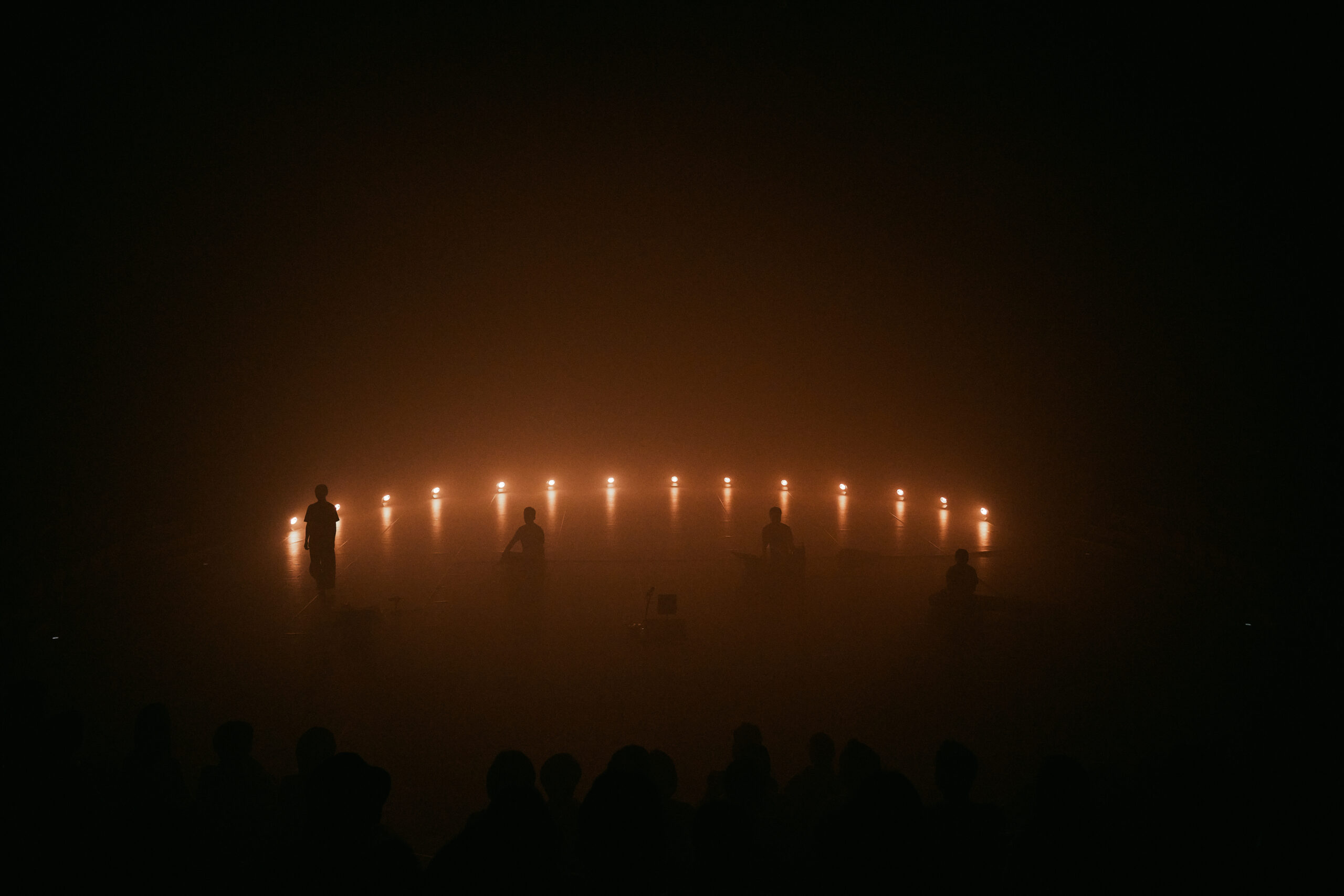
    Gagokbounce: One By One (2021-22) “can be seen as one of the rare examples of a fusion of two musical cultures, where the respective sensibilities and creative ideas are not simply blended, but clarified by each other”, as James Water observes, seeing this music as an homage to the art of Gagok, an instrumentally accompanied song art of the upper middle class in ancient Korea. Sebastian Claren compares the form of the composition Gagokbounce: One By One to “watching a film and repeating certain sections over and over again, sometimes slower, sometimes faster, sometimes shorter, sometimes longer, to better understand what exactly is shown on the screen”. In reference to the films and performances of Theresa Hak Kyung Cha from the 1970s, the musical atmosphere of this piece can be described as slow, sparse and hypnotic.


    Images of the staging and light design by Tilman Kanitz

    [/vc_column_text][/vc_column][/vc_row][vc_row][vc_column][weston_gallery ids=”1751,1750″][/vc_column][/vc_row]

  • Eden I

    Eden I

    [vc_row][vc_column][vc_column_text]Video: click and watch


    Something is lost here. There are many things that are obviously lost. Having a nice and affordable place to live in, for example, or strong unions. But it’s not that, it’s something else. It has left us in such a determined way, that it is impossible to say what that thing was, that got lost. It can’t have happened long ago. Maybe just five years, or twenty.
    Something is lost here, and we don’t know what it is. What was the thing that is now lacking? Was it subtle and fragile? We don’t know. We circle around that lack, follow its traces, trying to find out, how it came into being. Why did we start lacking it, and how? Through studying the story of this loss, we hope to get a feeling of what that thing could have been.

    Tilman Kanitz and Niklas Draeger teamed up with stage and costume designer Anna Philippa Müller and co-choreographers Frank Willens, Ixchel Mendoza and Shade Théret, to explore this loss in a spatial experiment: How to relate to the space we are in? How do environments support human relations, or evaporate them? How can we embody space? How do environments disperse or swallow sound? How can we listen to the surrounding sounds, what can we add, and how does this addition support or transform what is already there? How can we be together?

    CREDITS

    Concept, Direction & Choreography: Tilman Kanitz & Niklas Draeger
    Costume & Stage: Anna Philippa Müller
    Co-Choregraphy: Frank Willens, Ixchel Mendoza and Shade Théret
    Music: John Dowlan (Fantasia for Lute solo, Flow my tears for Lute and Voice), Ernstalbrecht Stiebler (Dd for Cello solo, Im Takt for Bongos), Tilman Kanitz (lines 1, vers. 1+2 for Cello solo), Ernstalbrecht Stiebler (organ flute), Alexander Iezzi (Bongos), Pedro Alcacer Doria (Lute), Tilman Kanitz (Cello)
    Dramaturgy: Niklas Draeger
    Dramaturgical consultancy: Chloe Firouzian

    With: Pedro Alcacer Doria, Ernstalbrecht Stiebler, Alexander Iezzi, Tilman Kanitz, Ixchel Mendoza, Shade Théret, Frank Willens, Elijas Willens, Niklas Draeger

    Artistic realisation Costume: Anna Philippa Müller & Ines Dautel
    Artistic realisation stage design bus: Leander Kreissl
    Stage & costume design apprentice: Sophia Mitterhofer
    Production-Assistant: Max von Mechow

    Documentation: Amelie Kahn-Ackermann (Foto), Chloe Firouzian (Foto & Video), Arnold Trautwein (Video)

    Supported by: The NATIONALE PERFORMANCE NETZ – STEPPING OUT NPN, funded by the Federal Government Commissioner for Culture and the Media as part of the NEUSTART KULTUR. Dance Aid Programme.

    Click for full size image.[/vc_column_text][/vc_column][/vc_row][vc_row][vc_column][/vc_column][vc_column][/vc_column][vc_column][/vc_column][/vc_row][vc_row][vc_column][weston_gallery ids=”1743″][/vc_column][/vc_row]

  • Clash

    Clash

    [vc_row][vc_column width=”1/3″][vc_wp_text][/vc_wp_text][/vc_column][vc_column width=”2/3″][vc_column_text]Clash de Cartier was an experimental music theatre and fashion show, commissioned by Cartier and art-directed by Tilman Kanitz. It was held at the Eissbach Studios in Munich. The audience was separated from the stage by a 30-by-8-metre transparent foil to keep the stage filled with fog and the audience space clear. Spectators experienced a dance and music performance that appeared and disappeared into the white clouds like ever-changing, blurred tableaux vivants. The music ranged from Purcell and Handel to contemporary pop and electronic music, including a premiere by Yello.


    Credit:

    Singers: Tahnee Niboro, Antigone Papoulkas
    Violin solo: Chouchane Siranossian
    Choreographer: Frank Willens
    Artistic Director: Tilman Kanitz[/vc_column_text][/vc_column][/vc_row]