[vc_row][vc_column width=”1/3″ animation=”wpb_bottom-to-top”][vc_column_text]Music: J.S. Bach, Wolfgang Rihm, John Cage
Choreographer: Laurent Chétouane[/vc_column_text][/vc_column][vc_column width=”2/3″ animation=”wpb_bottom-to-top” offset=”vc_hidden-xs”][vc_single_image image=”1087″ img_size=”full” add_caption=”yes”][/vc_column][/vc_row][vc_row][vc_column width=”1/3″][/vc_column][vc_column width=”2/3″][vc_column_text]
KHAOS
Today, the present is synonymous with crisis. Chaos no longer appears merely as a state of exception but as an equally threatening and seemingly inevitable “model” for the future. Chaos evokes fear. Yet in contrast to this modern notion of pure threat, Khaos in ancient Greek thought is a far more ambivalent figure. It gathers multiple layers of meaning: a yawning void, a cleft, a chasm, an abyss—but also the horizon of expansion, the immeasurable, the rupture or opening. As a formless form and a striving toward something other than what already is, Khaos invokes dimensions of emergence, possibility, and renewal.
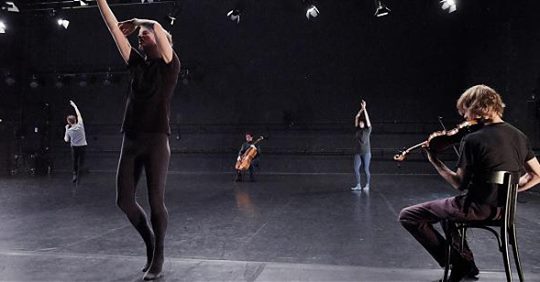
In KHAOS, Laurent Chétouane brings together four dancers and three musicians to explore the possibilities of Khaosat the edge of chaos itself. The performance unfolds to music by Johann Sebastian Bach, Wolfgang Rihm, and John Cage—composers whose works resonate with an affinity for the uncontrollable. These turbulence zones within and between the musical pieces become the point of departure for the emergence of unstable, threatening, and destructive spaces to which both performers and audience are equally exposed.
The traditional vertical axis of dance loses its visually organizing force; in these spaces—lacking fixed vectors and coordinates—the floor becomes the only point of support. Exposed to the possibility of falling, to loss, fear, and grief, dance evolves into an autonomous act of doing and becoming—a state without goal or predictable timeline. In this state, the body must discover new relations: to the Other, to the space, and to itself, in order not to be entirely consumed by blind and disparate forces or the contingency of openness.
KHAOS thus tests the danger of the dissolution of order in a single world through chaos as a field of play for the creation of multiple worlds.
Dance: Kotomi Nishiwaki, Tilman O’Donnell, Mikael Marklund
Music: Mathias Halvorsen (piano), Tilman Kanitz (cello), Artiom Schischkow (violin)
Choreography: Laurent Chétouane with the dancers
Musical Concept: Laurent Chétouane with the musicians and Johann Günther
Lighting: Jan Maertens
Costume Design: Lydia Sonderegger
Sound: Johann Günther
Dramaturgy: Marten Weise
Choreography Assistant: Sarah Blumenfeld
Costume Assistant: Anna Philippa Müller
Production: Christine Kammer, Hendrik Unger
Special thanks to Jean-Luc Nancy and Jean-François Peyret for their dramaturgical guidance and counsel.
A production by KHAOS GbR, co-produced with the Onassis Cultural Centre Athens, HAU Hebbel am Ufer Berlin, Kaaitheater Brussels, and Kampnagel Hamburg. Supported by the German Federal Cultural Foundation and the Basic Funding Berlin / The Governing Mayor of Berlin – Senate Chancellery – Cultural Affairs. With additional support from DOCK 11 / Eden***** Berlin.
–
KHAOS
Gegenwart heißt heute Krise. Das Chaos scheint nicht mehr nur Ausnahmezustand zu sein, sondern ein gleichermaßen bedrohliches wie unvermeidliches ‚Modell‘ für die Zukunft. Chaos macht Angst. Der Vorstellung einer ausschließlichen Bedrohung gegenüberstehend, ist das Khaos in der griechischen Antike eine ambivalentere Figur. Es versammelt unterschiedlichste Bedeutungsebenen: Gähnen, Kluft, Schlund, Abgrund. Aber es benennt auch den Horizont von Ausdehnung, Unermesslichkeit, Aufbrechen oder Öffnung. Als formlose Form und Streben in Richtung eines Anderen als es schon ist, ruft Khaos die Dimensionen des Entstehens, des Möglichen, der Erneuerung auf.
In KHAOS versammelt Laurent Chétouane vier TänzerInnen und drei Musiker zur Erkundung der Möglichkeiten des Khaos am Rande des Chaos. Auf der Bühne erklingt Musik von Johann Sebastian Bach, Wolfgang Rihm und John Cage, die eine Affinität zum Unkontrollierbaren aufweist. Die Turbulenzzonen in und zwischen den Musikstücken sind Ausgangspunkt der Entstehung instabiler, bedrohlicher, zerstörerischer Räume, denen PerformerInnen und ZuschauerInnen gleichermaßen ausgesetzt sind. Die traditionelle vertikale Achse des Tanzes verliert ihre visuell-ordnende Kraft und Halt bietet in diesen Räumen, ohne feste Vektoren und Koordinaten, nur noch der Boden. Der Möglichkeit des Sturzes, des Verlusts, der Angst und der Trauer ausgesetzt, wird der Tanz zu einem selbstständigen Tun und Werden, einem Zustand ohne Ziel oder planbare Zeitachse. Es entsteht dabei ein Körper, der neue Verhältnisse zum Anderen, zum Raum, zu sich selbst entdecken muss, um den blinden und disparaten Kräften, einer kontingenten Offenheit nicht ganz zum Opfer zu fallen. Die Gefahr einer Auflösung von Ordnung der einen Welt durch das Chaos wird in KHAOS als Spielraum der Schaffung multipler Welten erprobt.
Tanz: Kotomi Nishiwaki, Tilman O’Donnell, Mikael Marklund
Musik: Mathias Halvorsen (Klavier), Tilman Kanitz (Violoncello), Artiom Schischkow (Violine)
Choreografie: Laurent Chétouane mit den Tänzern
Musikalisches Konzept: Laurent Chétouane mit den Musikern und Johann Günther
Licht: Jan Maertens
Kostüm: Lydia Sonderegger
Ton: Johann Günther
Dramaturgie: Marten Weise
Assistentin Choreographie: Sarah Blumenfeld
Assistenz Kostüm: Anna Philippa Müller
Produktion: Christine Kammer, Hendrik Unger
Wir danken Jean-Luc Nancy und Jean-François Peyret für ihre dramaturgische Unterstützung und ihren Rat.
Eine Produktion der KHAOS GbR in Koproduktion mit dem Onassis Kulturzentrum Athen, HAU Hebbel am Ufer Berlin, dem Kaaitheater Brüssel und Kampnagel Hamburg.
Gefördert durch die Kulturstiftung des Bundes und die Basisförderung Berlin / Der Regierende Bürgermeister Berlin – Senatskanzlei – Kulturelle Angelegenheiten.
Mit Unterstützung von DOCK 11 / Eden *****, Berlin.[/vc_column_text][/vc_column][/vc_row]